
How a commercial solar project runs with Treetops
Site visit and consultation
We come to you, walk the building, inspect the electrical infrastructure, and talk through what you need the system to do. Consultation is by appointment and the initial visit is free.
Energy profile and system design
We analyse up to 12 months of your electricity bills to model your actual consumption, then design a system around it. You receive a detailed proposal with system specs, projected generation, savings and payback — numbers we stand behind.
Finance structure and approval
Capex, third-party lending or PPA. We help you choose the structure that fits your business and coordinate with your finance partners as needed.
Installation
Our in-house teams handle the roof, electrical, inverter and battery work, and integration with your existing infrastructure. Timelines are built around your operational requirements — production schedules, school terms, trading hours, harvest cycles.
Commissioning and SSEG registration
Engineer inspection, full system commissioning, and SSEG registration with your municipality. The system only goes live once everything is signed off and operating to specification.
Handover, training and documentation
You receive the full project documentation pack, monitoring platform access, and training for whoever on your team needs it. We walk you through how the system operates and what to expect through the seasons.
Ongoing monitoring and support
Every system we install is monitored remotely for its entire operating life. We see performance issues before you do, and we act on them — often before you're even aware there's something to address.
Enjoy the savings — and start plotting what's next
The first year is when the numbers in our proposal become numbers on your bank statement. The second year is usually when clients start asking about phase two. Whether it's expanding the array, adding storage, or electrifying vehicles and processes, we'll design the original system to make whatever comes next as straightforward as possible.
How a commercial solar project runs with Treetops
Site visit and consultation
We come to you, walk the building, inspect the electrical infrastructure, and talk through what you need the system to do. Consultation is by appointment and the initial visit is free.
Energy profile and system design
We analyse up to 12 months of your electricity bills to model your actual consumption, then design a system around it. You receive a detailed proposal with system specs, projected generation, savings and payback — numbers we stand behind.
Finance structure and approval
Capex, third-party lending or PPA. We help you choose the structure that fits your business and coordinate with your finance partners as needed.
Installation
Our in-house teams handle the roof, electrical, inverter and battery work, and integration with your existing infrastructure. Timelines are built around your operational requirements — production schedules, school terms, trading hours, harvest cycles.
Commissioning and SSEG registration
Engineer inspection, full system commissioning, and SSEG registration with your municipality. The system only goes live once everything is signed off and operating to specification.
Handover, training and documentation
You receive the full project documentation pack, monitoring platform access, and training for whoever on your team needs it. We walk you through how the system operates and what to expect through the seasons.
Ongoing monitoring and support
Every system we install is monitored remotely for its entire operating life. We see performance issues before you do, and we act on them — often before you're even aware there's something to address.
Enjoy the savings — and start plotting what's next
The first year is when the numbers in our proposal become numbers on your bank statement. The second year is usually when clients start asking about phase two. Whether it's expanding the array, adding storage, or electrifying vehicles and processes, we'll design the original system to make whatever comes next as straightforward as possible.
Projects across every sector that matters
We've built systems for healthcare campuses that can't afford a second of downtime, schools that need to keep exams running, wine farms with irrigation and cold storage loads, shopping centres with dozens of tenants and complex metering, and manufacturers running shift work. Different sectors, different problems, same approach: understand what the client actually needs, then engineer the system around it.
Healthcare & Laboratories
Healthcare and laboratory environments run on a different risk profile from almost any other sector. Diagnostic equipment, sample storage, refrigeration for reagents and specimens, IT infrastructure carrying patient data — none of it tolerates interruption. Any solar and battery system installed here has to be engineered around uptime first and savings second.
In its first full year of operation, the system generated over 1 million kWh and reduced PathCare's electricity and diesel spend by approximately R4.5m, including kVA demand charges.
Education
Schools and educational institutions operate under constraints that most commercial sectors don't face. Budgets are tight and scrutinised by boards and parent bodies. Term-time disruption isn't an option, which means installation work has to happen during school holidays on a fixed timeline. And beyond the financial case, schools increasingly need resilience — exams, online learning, security systems and boarding facilities all depend on continuous power.
In practice — Rustenburg Girls' High School 212kWp solar + 400kWh battery storage. The largest SolarEdge battery installation in the Western Cape at the time of commissioning.
RGHS produces over 330,000 kWh of free electricity and saves over R700,000 every year, while providing reliable backup for critical operations.
Retail & Shopping Centres
Multi-tenant retail is one of the most technically demanding environments for commercial solar. A shopping centre isn't a single building with a single electrical supply — it's dozens of tenants with their own meters, leases and consumption patterns, a roof already crowded with HVAC and services, and multiple electrical tie-in points serving different sections of the property. The commercial case is strong — centres run during daylight hours and common-area electricity is typically the landlord's direct cost — but the engineering has to work around the existing infrastructure, not against it.
In practice — Mitchells Plain Plaza 744kWp grid-tied solar system engineered across two separate electrical infrastructures. One of the larger commercial rooftop installations in the Western Cape.
The Plaza produces over 1,100,000 kWh of free electricity and saves over R3,000,000 every year.
Wine, Agriculture & Farming
Wine farms and agricultural operations have an energy profile that's almost perfectly suited to solar — and almost perfectly mismatched to the way most installers approach a quote. Loads are heavy but seasonal: irrigation pumps run hard through summer, cellar refrigeration runs continuously, harvest brings sharp peaks in pressing and processing, and frost protection draws unexpected current at unexpected hours. Designing a system for this environment means working around the actual rhythm of the farm and the realistic constraints of electrical infrastructure that's often been built and extended in stages over decades.
In practice — Spookfontein Wine Farm, Hemel-en-Aarde 44kWp solar + 60kWh battery storage. A complete energy solution for a working wine farm in one of the Cape's premium wine regions.
Spookfontein produces over 60,000 kWh of free electricity every year, while providing reliable backup for cellar operations.
Residential Estates & Retirement Complexes
Estates and retirement complexes occupy a category of their own — shared infrastructure serving dozens or hundreds of residents, governed by a body corporate or HOA, and answerable to owners, trustees and residents with different priorities. The energy profile is distinctive too: common-area lighting, security, gates, water pumping, irrigation, clubhouse facilities and lifts all run on the body corporate's account, and in retirement complexes frail-care facilities and medical equipment add resilience requirements that can't be compromised. A system in this environment has to deliver measurable savings, provide reliable backup for the services residents depend on, and operate quietly in the background for decades.
In practice — Wytham Estate 134kWp solar + 400kWh Freedom Won battery storage with a 150kVA inverter. A full energy solution for an estate where reliability and aesthetics both mattered.
Wytham Estate produces over 180,000 kWh of free electricity and saves over R400,000 every year, while providing reliable backup for common-area infrastructure and critical services.
Manufacturing & Print
Manufacturing and print operations run on schedule. Production lines, presses, compressors and process equipment draw heavy, sustained loads during operating hours, and any interruption — from a grid outage or a poorly executed installation — translates directly into lost output, missed deadlines and contractual exposure. The financial case is unusually strong: daytime operating hours align almost perfectly with solar generation, loads are predictable and continuous, and many manufacturing tariffs include kVA demand charges that a properly designed system can directly address. A phased approach often works particularly well here — prove the case with an initial installation, measure the actual savings against the model, then scale up with confidence.
In practice — JSSL (Julius Solomon Specialist Labels), Maitland Two phases of 100kWp each, with a third phase of 100kWp plus battery storage currently in planning. A specialist label printing operation with continuous daytime production loads.
JSSL produces over 320,000 kWh of free electricity and saves over R600,000 every year across both phases.
Processing & Extraction
Processing and extraction facilities operate at the demanding end of the industrial spectrum. Continuous loads, large motors, heat-sensitive processes and batch cycles that can't be interrupted — and power quality matters as much as power availability, because voltage dips and supply instability can damage equipment, compromise product quality and force expensive process restarts. Any solar installation has to integrate with the existing electrical system without introducing risk on the production side. The commercial case is compelling: predictable daytime loads align well with solar generation, and industrial tariffs with kVA demand charges and time-of-use pricing are exactly the cost structures a properly designed system — with or without battery storage — can directly address.
In practice — Afriplex, Paarl 160kWp solar. A botanical extraction and ingredient manufacturing facility supplying into the nutraceutical, pharmaceutical and food sectors.
Afriplex produces over 250,000 kWh of free electricity every year.
Our latest commercial solar and battery projects across Cape Town and the Western Cape
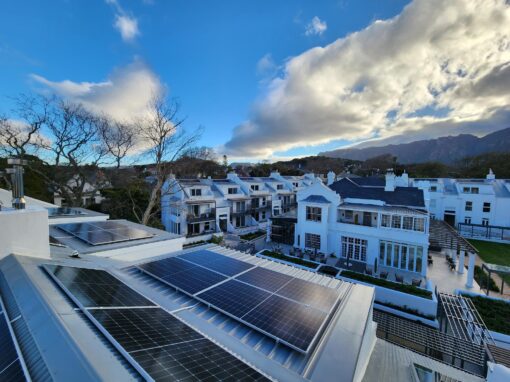


What a commercial solar system actually does for your business

Cuts your electricity bill by up to 80%

Locks in your electricity cost for 25+ years

Addresses kVA demand charges and time-of-use tariffs

Earns SSEG credits for excess solar generation
Reduces carbon tax exposure and strengthens sustainability reporting
Protects uptime with commercial battery storage
What your monthly electricity bill tells us
Every commercial solar project starts with a conversation about your current bill. The structure of that bill — not just the total — tells us what's possible, what's worth prioritising, and what kind of system makes sense for your operation.
Under R30,000 / month
Small commercial
R30,000 – R100,000 / month
Mid-size commercial
R100,000 – R500,000 / month
Large commercial & light industrial
Above R500,000 / month
Heavy commercial & industrial
Not sure which bracket you're in? Bring your last twelve months of bills to a consultation — we'll model the system, the savings, and the payback against your actual numbers.
Why Treetops is the Western Cape's commercial solar specialist
Choosing a commercial solar installer is a long-term decision. The system you put on your roof today has to perform for 25 years, through tariff changes, equipment upgrades, and every grid condition in between.
These are the four things that shape how we approach that responsibility — on every project, at every scale.

Everything in-house, from engineering to commissioning
Design, electrical engineering, roof installation, SSEG applications, monitoring and ongoing support all happen under one roof. There are no subcontractors disappearing between phases, no handoffs where critical detail gets lost, and no finger-pointing when something needs to be resolved. The engineer who designs your system is part of the same team as the technicians who install it and the support staff you'll deal with two years in.
For commercial clients, that continuity is the difference between a project that runs to plan and one that doesn't. It's also why the same person who understands your site in month one is still the person answering your call in year five.

Engineering complexity is where we live
The projects in our portfolio aren't standard installations. They're the ones where generic solutions stop working and real engineering has to take over:
— Consolidating two separate electrical supplies into a single integrated system at PathCare's N1 City campus.
— Engineering a 744kWp array across two tie-in points at Mitchells Plain Plaza.
— Commissioning the largest SolarEdge battery installation in the Western Cape at Rustenburg Girls' High School.
— Installing 200kWp over a few years for JSSL, growing the system with their company requirements
Each of these projects required engineering decisions that couldn't be solved with a standard quote. They're the work we've been doing for over a decade, and they're why clients with genuinely complex sites trust us with theirs.

Herholdt's Platinum Partner status
Treetops is one of a small number of South African installers with Platinum Partner status from Herholdt's, the country's leading solar distributor. In practical terms, that means direct manufacturer support, prioritised stock allocation, faster warranty resolution, and access to engineering resources that aren't available to general installers.
For commercial clients, it's the difference between a 48-hour fix and a six-week wait when something needs attention — and the difference between a system that stays running and one that sits idle waiting for parts.

Monitoring and after-sales support for the full life of your system
Every system we install is monitored remotely from our offices for the full length of its operating life. We see performance issues before you do, and we act on them — often before you're even aware there was something to address. Proactive maintenance is scheduled around the actual condition of your system, not a generic service contract.
The real test of a solar installer isn't how they sell the project. It's what happens in year three, year seven, year fifteen — when the installation is long done and the system needs attention. Commercial clients who've been with us for over a decade are still dealing with the same team that built their original system. That's not a policy. It's how we operate.
The technology we install for commercial solar
Commercial solar and battery systems aren't the place to experiment with unproven hardware or incompatible combinations. At the scale we work at — 100kWp to 1MWp and beyond, often with substantial battery storage — every component has to integrate cleanly with every other component, perform reliably for 25 years, and be backed by local technical support that will still exist when something needs attention a decade from now.
Our commercial technology stack reflects that reality. It's narrower than it used to be, and more deliberate.
Why we moved to single-vendor systems
For most of the last decade, commercial solar installations were assembled from best-in-class components across multiple manufacturers — one brand's inverter, another brand's battery, a third brand's monitoring platform. It worked, but it also introduced quiet risks. Components that weren't designed to communicate with each other had to be forced to cooperate. Firmware updates from one manufacturer could affect behaviour from another. Warranty claims became a conversation about whose fault it was.
The industry has shifted, and so have we. Modern commercial platforms from Sungrow and SigEnergy are designed as integrated systems — inverter, battery, monitoring and control all engineered to work together from the ground up. For new commercial installations, that integration is now the default — and the performance, reliability and long-term supportability are all better for it.
Current inverters and battery systems
Historical commercial systems we continue to support
ATESS & Freedom Won
SolarEdge
Solar panels
JA Solar & Canadian Solar
Monitoring and system integration
We use each manufacturer's native monitoring platform — Sungrow, SigEnergy, SolarEdge and ATESS all provide detailed performance data, fault detection and remote diagnostics as part of their integrated systems.
For commercial clients who need deeper integration into existing building management or industrial control systems, we deploy EnergiTrack for SCADA integration — giving operations teams live system data alongside the rest of their process monitoring infrastructure.
What we don't install on commercial projects
Not every brand that works for a home belongs on a commercial roof. Sunsynk and Deye — both common in the South African residential market — aren't engineered for commercial-scale loads, commercial tariff structures, or the continuous-duty performance a commercial installation demands. We install them in the residential market where they're appropriate, but we don't recommend them for commercial or industrial work.
Saying this out loud matters, because a lot of commercial buyers have been quoted Sunsynk or Deye systems by installers who treat commercial solar as a scaled-up version of a residential job. It isn't. Commercial and residential solar are different engineering disciplines, and the technology choice has to reflect that.
How you pay for your commercial solar system
Capex purchase
Third-party lending
Power Purchase Agreement (PPA)
Not sure which structure fits your business? We've helped clients across every sector work through this decision; based on your business, not a template.
The questions commercial clients ask before they call us.
What size solar system does my business need?
It depends on your consumption pattern, your tariff structure, your roof, and what you want the system to achieve. Most commercial systems we install fall between 50kWp and 800kWp, but we've built smaller and we've built much larger. We size every project off 12 months of actual electricity bills — not estimates, not industry averages — so the system matches your real operation rather than a generic load profile.
What ROI can I expect from a commercial solar system?
Most commercial systems deliver 16% or higher ROI in year one, and that figure grows as electricity tariffs increase. Systems without battery storage often exceed 40% return in the first year. Systems with BESS typically return 20% or more once the resilience value and demand-charge reduction are factored in. We model the full 25-year financial picture for every commercial client before a proposal is signed.
How long does a commercial solar installation take?
From signed proposal to switch-on is typically 6–16 weeks, depending on system size, complexity, municipal approval timelines, and stock availability. Larger projects with battery storage and multiple tie-in points take longer. We give you a realistic timeline at design stage and we stick to it.
What happens to my business during load shedding or grid outages?
Solar alone doesn't run during a grid outage — it needs battery storage to provide backup. If uptime matters to your operation, we design the system with a BESS sized to your critical loads. Some clients back up the entire operation, others back up only what can't go down. We work through that decision with you based on what an outage actually costs your business versus the cost of the storage capacity needed to prevent it.
Do you handle SSEG registration and municipal compliance?
Yes — every commercial system we install is registered with the relevant municipality, and we handle the entire process as part of the project. We've been doing SSEG applications across Cape Town, Stellenbosch, Drakenstein, Overstrand and the broader Western Cape since the framework was first introduced. You don't need to speak to a single official.
How do kVA demand charges work and can solar reduce them?
Industrial and large commercial tariffs include a kVA demand charge based on the highest power draw recorded during the billing period — and notified maximum demand penalties on top of that. These charges can account for a substantial share of your monthly bill. A properly designed solar system, particularly one with battery storage, can flatten demand peaks and shift load away from the most expensive tariff periods. For some clients, demand-charge reduction alone justifies a significant portion of the project.
How long will a commercial solar system last?
Solar panels are warrantied for 25 years and typically continue producing well beyond that. Inverters are warrantied for 10–12 years and replaced once during the system's operating life. Lithium batteries are warrantied for 10 years. The system as a whole is designed to operate reliably for 25+ years, and the financial modelling is built around that timeline.
Can I add battery storage to a commercial system later?
Yes — and we design our systems to make that straightforward. If your priority today is cost savings and you want to add resilience later, we'll engineer the system to accept storage when you're ready. That's exactly the path JSSL has followed with us — phase one and phase two as solar-only, with battery storage being added in phase three.
What if my business already has a solar system that needs upgrading?
Retrofitting and upgrading existing systems is one of our specialties. We assess what you've got, tell you honestly what's possible and what it will cost, and design the upgrade around your existing installation rather than starting from scratch. Adding storage, expanding capacity, replacing aging inverters — all of it is worth a conversation.
Can solar work for my business if I rent the building?
Sometimes yes — it depends on your lease arrangement and your landlord's willingness to engage. In some cases the landlord benefits from the installation increasing the property's value, which opens the door to a conversation. PPA structures can also make this easier, since the system is owned by a third party rather than the tenant or the landlord. We've made it work in situations that initially seemed complicated.
What about businesses with multiple buildings or supply points?
We've designed and built systems across multiple tie-in points on a single property — PathCare's N1 City campus is a good example, where we consolidated two separate supplies into one integrated solar and battery installation. Mitchells Plain Plaza is another, with a 744kWp array engineered across two separate electrical infrastructures. Multi-site and multi-supply projects require more detailed planning, but the principles are the same.
What happens if something goes wrong with the system?
Every system we install is monitored remotely from our offices, which means we often know about a fault before you do. If something needs attention, we respond — you're not logging a ticket with a call centre or waiting for a manufacturer's warranty claim to process. We're a Cape Town-based team and your system is our responsibility long after the installation is complete.
Ready to cut costs and protect uptime?
Consultation is by appointment. We come to you, walk the site, look at the actual building and the actual bills, and tell you what makes sense — and what doesn't. No call-centre handoffs, no junior sales reps, no pressure. Just a straight conversation about what a properly engineered solar and storage system would do for your operation.